
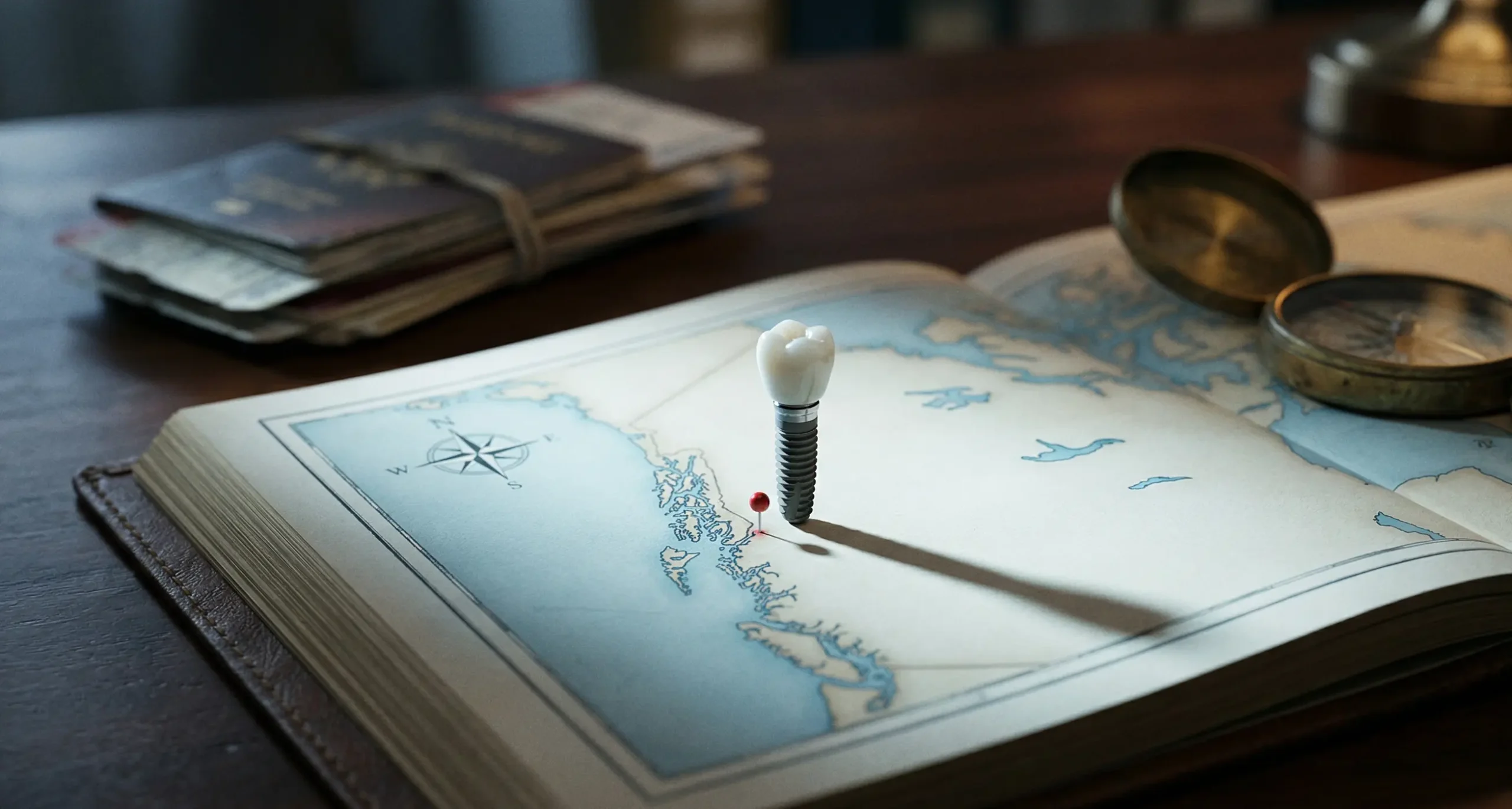
A single dental implant in Ontario costs $3,000 to $6,000. The same procedure in Mexico, Turkey, or Thailand might be quoted at $800 to $1,500. Full arch implants that run $25,000 here can be found abroad for $8,000 to $12,000.
Those numbers are tempting. And every year, thousands of Canadians fly overseas for dental work.
Some come back happy. Many do not. And the ones who do not are the patients we end up seeing months later, often in worse shape than before they left.
This is not a scare piece designed to keep you from saving money. Dental tourism is a real industry with real providers, some of whom are excellent. But the risks that come with it are also real, and they rarely show up in the glossy before-and-after photos on a clinic’s Instagram page.
Before getting into the risks, it helps to understand why the price gap exists. It is not because Canadian dentists are gouging you.
Lower cost of living. Office rent, staff salaries, lab costs, and utilities are all lower in popular dental tourism destinations. This naturally brings procedure costs down.
Lower regulatory overhead. Canadian dental practices must comply with provincial infection control standards, radiation safety protocols, and continuing education requirements that are among the strictest in the world. Not every country operates at this level. Some do, but not all.
Volume-based models. Many dental tourism clinics process a high volume of patients quickly. This assembly-line approach keeps per-patient costs down, but it also means less personalized treatment planning and shorter appointment times.
Material and implant brand differences. Premium implant systems from manufacturers like Straumann, Nobel Biocare, and Dentsply Sirona cost more because they come with decades of clinical research behind them. Some overseas clinics use lesser-known implant brands with limited long-term data. The implant might look the same on an X-ray, but the surface treatment, connection design, and quality control can be very different.
Implant placement is a surgical procedure. Complications can happen days, weeks, or months after surgery. If you develop an infection, the implant fails to integrate, or the crown does not fit properly, you need access to the provider who did the work.
When that provider is a 10-hour flight away, your options narrow quickly. You either fly back (adding travel costs and time off work) or you find a local dentist willing to troubleshoot someone else’s work with incomplete records.
Most Canadian dentists will help in an emergency, but they are working blind. They do not know what implant system was used, what the surgical protocol was, or how the bone was prepared. This makes problem-solving harder and more expensive.
A good implant case starts with thorough diagnostics: a cone beam CT scan, periodontal evaluation, medical history review, and a treatment plan that accounts for your bone quality, bite alignment, and long-term goals.
Some dental tourism clinics do this well. Others compress the entire process into a one-week visit. You fly in, get scanned, get surgery, get a temporary restoration, and fly home. The speed is part of the appeal, but it also means less time to catch issues that could affect outcomes.
For example, bone grafting may be recommended but skipped to keep the treatment within a single trip. Implants placed into insufficient bone have higher failure rates. The research on this is clear.
Here is a problem that does not surface until something goes wrong. If the implant system used abroad is not commonly available in Canada, getting replacement parts (abutments, screws, specialized tools) becomes difficult.
Implant components are not universal. A screw for a Straumann implant does not fit a MIS or Osstem implant. If you need a repair or replacement years later, your Canadian dentist needs to identify the exact system and order the right parts. If the brand is obscure or no longer manufactured, this becomes a serious problem.
Before traveling, ask the clinic exactly which implant system they use and verify that it is available in Canada.
Canada’s provincial dental regulatory bodies enforce strict infection control protocols. Autoclaving instruments, single-use barriers, water line testing, and PPE requirements are all monitored and audited.
In many popular dental tourism countries, the top-tier clinics meet or exceed these standards. But mid-range and budget clinics may not. And as a foreign patient, you have no easy way to verify compliance. You cannot check inspection records. You cannot read regulatory body complaints. You are trusting the clinic’s self-reported standards.
If something goes wrong with dental work in Ontario, you have options. You can file a complaint with the Royal College of Dental Surgeons of Ontario. You can pursue a claim through the court system. Your dentist carries malpractice insurance.
Abroad, your legal options are limited or nonexistent. Different countries have different patient protection frameworks, and pursuing a claim from Canada is expensive, slow, and rarely successful.
At our practice, we have treated patients returning from dental tourism with a range of issues. These are not rare edge cases. They represent patterns.
Implants placed at the wrong angle, causing bite problems and excessive stress on the bone. Crowns that do not match the patient’s natural tooth shape or color. Infections from implants placed into sites that needed grafting first. Temporary restorations that were supposed to be replaced with permanent ones, but the patient never went back for the second trip. Unknown implant brands that required guesswork to service.
In some of these cases, the implant had to be removed entirely, and the patient started over from scratch. They ended up spending more than they would have if they had done the work locally from the start.
To be fair, not every dental tourism experience ends badly. Some patients do well, especially when they:
Choose accredited clinics affiliated with recognized dental organizations in their country. Verify the implant brand being used and confirm it is serviceable in Canada. Budget for a follow-up trip if complications arise. Bring all records (CT scans, treatment plans, implant lot numbers) home with them. Have realistic expectations about the timeline and do not rush critical healing phases.
If you are seriously considering dental tourism, treat the research process the same way you would for a major surgical procedure. Ask for credentials, read reviews from sources other than the clinic’s own website, and get an independent assessment from a local dentist before and after.
The real question is not “can I save money?” The answer is usually yes, at least upfront. The real question is “what happens if something goes wrong, and can I handle that risk?”
If you are confident in the overseas provider, comfortable with the travel logistics, and have a plan for follow-up care, dental tourism might work for you.
But if you value knowing your provider, having local access for complications, and using an implant system with long-term research backing, doing the work closer to home offers peace of mind that is hard to put a dollar figure on.
If you are comparing options and want an honest assessment of what your case would cost locally, reach out to us for a consultation. We will give you a detailed treatment plan with clear pricing so you can compare apples to apples.