
All-on-4 implants are one of the most marketed dental procedures in North America right now. The pitch is straightforward: replace an entire arch of teeth using just four implants, often in a single day, with a fixed prosthesis that looks and feels like real teeth.
For the right patient, it works. For the wrong patient, it is an expensive problem.
And the reason some dentists refuse to offer All-on-4 has nothing to do with a lack of training or fear of the procedure. It has to do with how aggressively the treatment is sold to people who may not be good candidates for it.
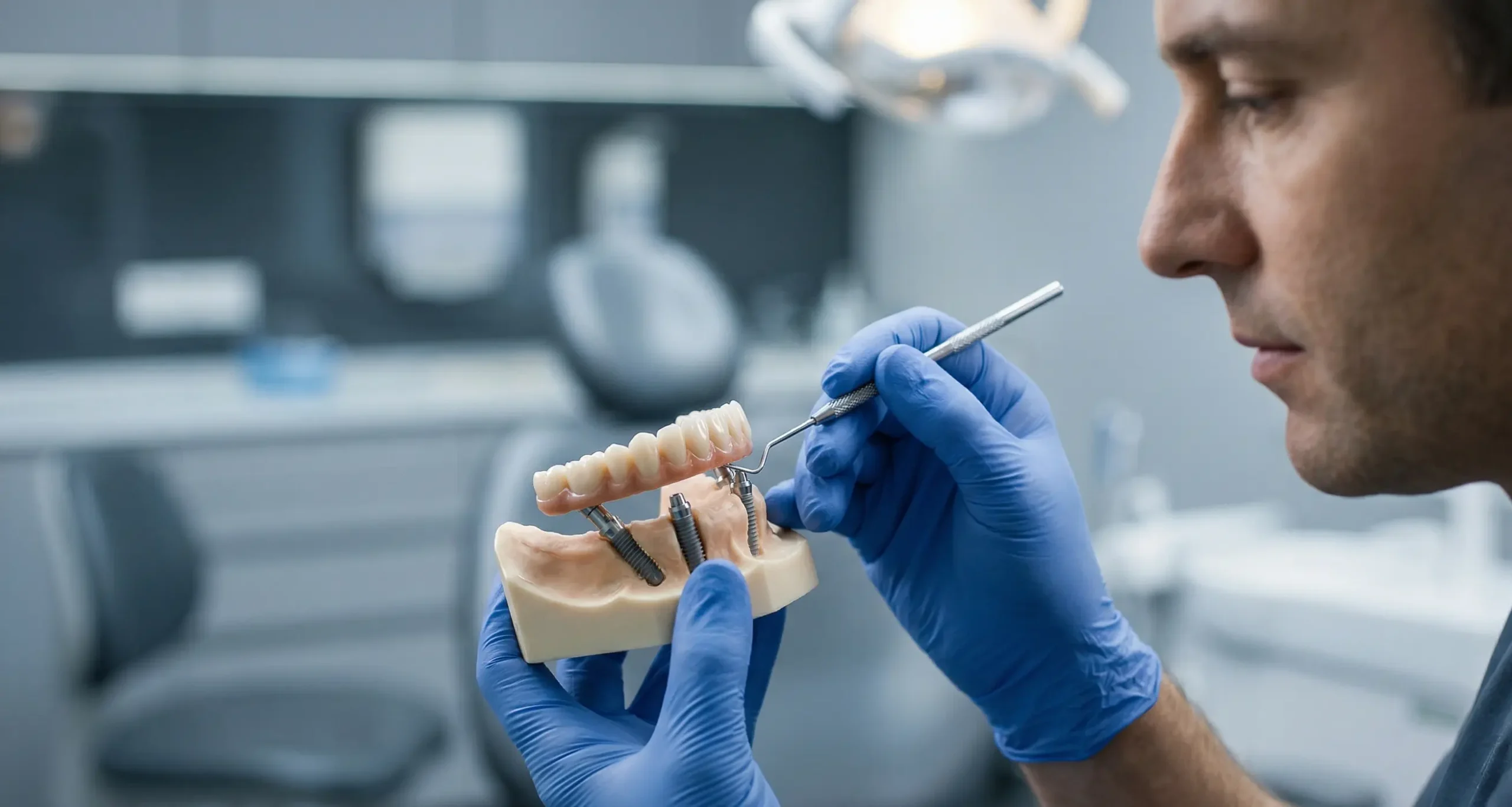
The concept was developed by Dr. Paulo Malo in the late 1990s and commercialized primarily through Nobel Biocare. The idea is to use four strategically angled implants, two placed straight in the front of the jaw and two tilted at up to 45 degrees in the back, to support a full arch of prosthetic teeth.
The angled rear implants are the key innovation. By tilting them, the surgeon can anchor into denser bone at the front of the jaw and avoid the need for bone grafting or sinus lifts in many cases. This reduces surgical complexity, shortens treatment time, and opens the door for patients with moderate bone loss who might not qualify for traditional implant placement.
In many cases, the remaining teeth are extracted, the implants are placed, and a temporary fixed prosthesis is attached the same day. The patient walks out with a full set of teeth. The final prosthesis is fabricated and placed months later once the implants have fully integrated.
That same-day transformation is what makes All-on-4 so appealing to patients. It is also what makes it so marketable. And marketability is where the problems begin.
The controversy around All-on-4 is not about whether it works. It does. Published research shows survival rates comparable to traditional implant approaches, typically in the 93% to 98% range at 5 to 10 years.
The debate is about three things: patient selection, long-term durability, and whether four implants are always enough.
Some prosthodontists and implant specialists argue that four implants are adequate for many patients, particularly in the lower jaw where bone density is naturally higher. But for the upper jaw, where bone is softer and resorption is more common, four implants may not provide enough support for the long haul.
This is why you will also see “All-on-5” or “All-on-6” protocols, sometimes referred to broadly as All-on-X. The “X” acknowledges that the ideal number of implants varies by patient. Some jaws need four. Others need six. Some need more.
Clinics that rigidly market “All-on-4” as a one-size-fits-all protocol may be prioritizing the brand name over clinical judgment.
All-on-4 was designed for patients with significant tooth loss or failing dentitions who have enough bone in the anterior jaw to support angled implants without grafting. It works best for patients who are otherwise healthy, non-smokers (or willing to quit), and committed to maintenance.
It is less ideal for patients with very severe bone loss (where even angled implants cannot find adequate bone), patients with uncontrolled diabetes or immune conditions, heavy smokers, and patients who grind their teeth aggressively.
The concern among more conservative practitioners is that some clinics extend the candidate pool beyond what the research supports, driven by the high revenue per case and patient demand for a “quick fix.”
With a traditional implant approach using six to eight implants per arch, losing one implant is usually not catastrophic. The remaining implants can still support the prosthesis while the failed site heals.
With All-on-4, losing even one of the four implants can compromise the entire prosthesis. The remaining three may not distribute forces evenly, leading to overload and potential cascade failure.
This is the structural argument against minimizing implant count. Fewer implants means less redundancy, and less redundancy means higher stakes if something goes wrong.
Dentists who decline to offer All-on-4 typically fall into a few categories.
They believe more implants are safer. Some practitioners prefer placing five, six, or more implants per arch to build in redundancy. They are not against the fixed full-arch concept. They just think four is too few for most patients.
They are uncomfortable with the marketing. The All-on-4 brand has been heavily marketed through franchise-style dental chains and direct-to-consumer advertising. Some of this advertising promises “new teeth in a day” without adequately disclosing the risks, the need for a second surgery to place the final prosthesis, or the possibility that additional procedures may be needed.
Dentists who prioritize informed consent may feel the marketing climate around All-on-4 works against honest patient education.
They have seen the complications. Dentists who regularly receive referrals for failed implant cases see a disproportionate number of All-on-4 failures, often from high-volume clinics that prioritized speed over patient selection. These experiences shape their clinical philosophy.
They prefer staged approaches for complex cases. For patients with severe bone loss, active periodontal disease, or medical complications, a staged approach (grafting first, implants later, prosthesis after full integration) may produce better long-term results. The same-day appeal of All-on-4 does not suit every clinical scenario.
The counterargument is equally valid.
All-on-4 has more than 20 years of published clinical data supporting its effectiveness. For many patients, especially those with moderate bone loss who want to avoid grafting, it is a well-designed solution that delivers excellent quality of life.
The reduced number of implants means less surgery, less cost, and faster recovery. For elderly patients or those with health conditions that make prolonged surgical procedures risky, fewer implants can actually be the safer choice.
And the psychological benefit of walking out of surgery with teeth, rather than waiting months in a temporary denture, is significant. For patients who have lived with failing teeth or uncomfortable dentures, that single-day transformation is life-changing.
The issue is not the procedure. It is how it is applied and who it is offered to.
Whether a clinic calls it All-on-4, All-on-6, or All-on-X, here are the questions that matter:
How many implants are you recommending for my specific case, and why? What happens if one of the implants fails? Will I need bone grafting, or are we avoiding it, and what are the trade-offs? Who performs the surgery, and what is their implant case volume? What is included in the quoted price (temporary prosthesis, final prosthesis, follow-up care)? Can I see the treatment plan and imaging before committing?
The best providers will welcome these questions. If a clinic responds with pressure instead of answers, that tells you something.
All-on-4 is a valuable option in modern dentistry. It is not a scam, and it is not a miracle. It is a specific surgical protocol that works well for the right patient and can fail for the wrong one.
The right approach for your jaw, your bone, and your health might be four implants. It might be six. It might be a different solution entirely. What matters is that the recommendation comes from a thorough assessment of your case, not from a marketing playbook.
If you are exploring full arch replacement and want a second opinion or an honest assessment of your options, schedule a consultation with our team. We will review your imaging, discuss what your jaw actually needs, and give you a clear plan with no pressure.