

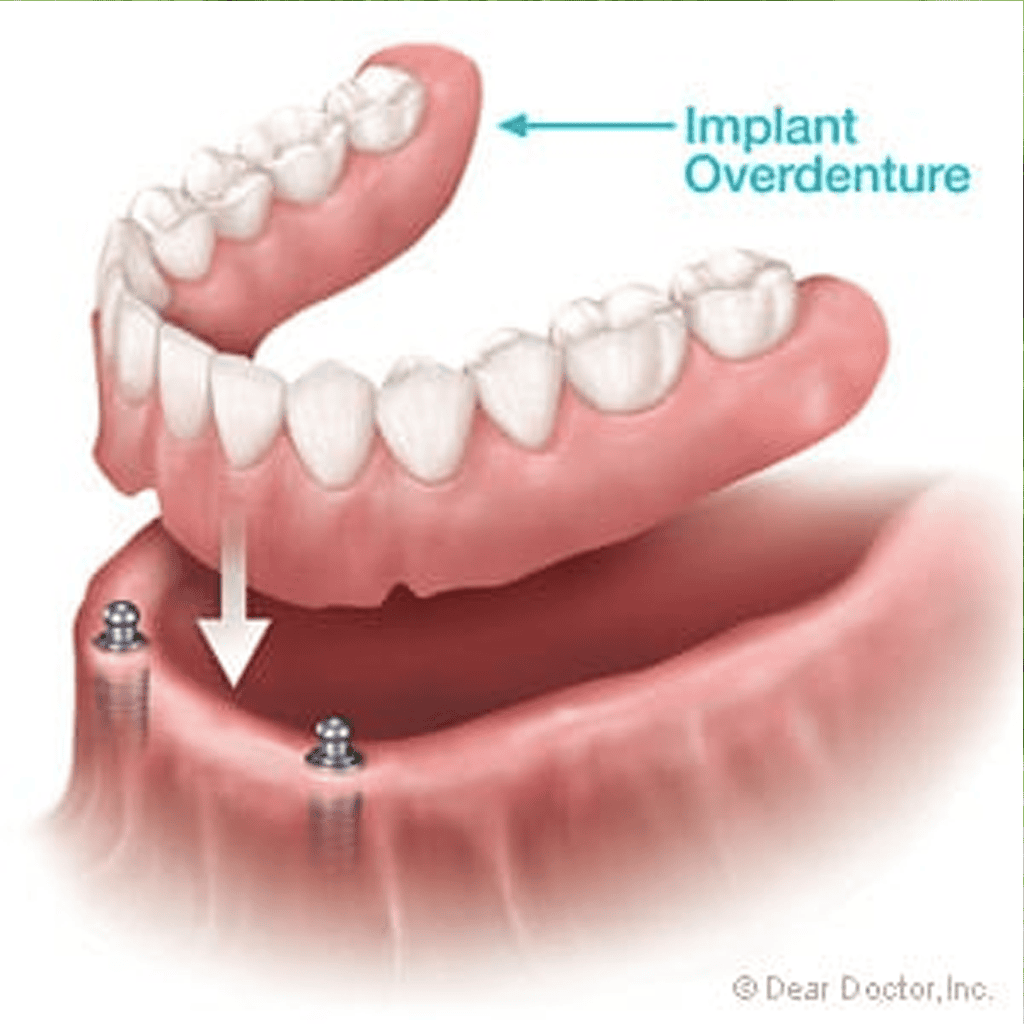
Yes, most people with bone loss can wear dentures. How well they fit depends on how much bone is left.
Bone loss in the jaw is common after teeth are lost. Below, we explain why it happens, what dentures can and cannot do about it, and when dental implants or a bone graft may help.
Your tooth roots are set in the jawbone. Each time you bite and chew, the roots press on the bone, and that pressure helps the bone remain strong.
When a tooth is lost, that pressure stops. The bone around the tooth slowly shrinks, and the gums on top shrink with it. Gum disease can also wear away the bone around teeth before they are lost.
The shrinking goes on over the years. The ridge of bone that a denture rests on gets lower and narrower, which is why dentures tend to get looser with time.
No. A regular denture rests on top of your gums.
It does not reach into the bone the way a tooth root does, so it cannot give the bone the pressure it needs. The bone under a denture goes on shrinking.
The American Academy of Implant Dentistry says the pressure of a denture on the gums can even speed bone loss up. That is one reason a denture that used to fit well can start to slip, rub or click.
Partial dentures work the same way. A partial fills the gaps and clips onto your own teeth, but it does not stop bone loss in the gaps. It does let you chew and smile with a full row of teeth again.
A denture can be made to fit a smaller ridge of bone. An upper denture also rests on the roof of your mouth. A lower denture rests only on the ridge of the jaw, so a lower denture can move more when bone is lost there.
As the bone goes on changing, the fit can often be brought back with a reline, a new layer on the inside of the denture. When a reline is not enough, a new denture is made to match your mouth as it is now. Read more about dentures in London, Ontario.
Dental implants are small posts placed in the jawbone, where tooth roots used to be. Implants can anchor a denture, so it no longer rests only on the gums. There are two main kinds:
You may hear fixed implant dentures called permanent dentures. That name only means they are fixed to implants and you do not take them out at home. Like any denture, they need daily cleaning and regular checkups.
Implants also press on the bone when you chew, a bit like tooth roots do. The American Academy of Implant Dentistry says this helps slow the shrinking of the jawbone.
Each implant needs enough healthy bone around it to grip it firmly. So before we plan anything, we check how much bone you have.
Our office has a cone beam CT scanner. It takes a 3D picture of your jaw, so we can see the height and width of the bone where an implant would go. Read more about dental implants in London, Ontario.
Sometimes there is not enough bone left to support an implant. A bone graft can help.
Grafting material is placed where the bone is thin, to build it back up and give implants a strong base. A graft can also rebuild the jaw before a new denture.
A graft needs time to heal before implants go in. The first healing takes about a week, but a graft can take up to a year to heal fully.
That is why a plan with a graft takes longer. Read more about bone grafting at our office.
Bone loss does not have to mean a loose denture for good. Call 519-472-4460 to book a visit. We will look at your mouth and your bone, then go over the choices that suit you.
We are on Aldersbrook Road and open until 7pm on Monday and Tuesday.


